In high-frequency consumer payments, every millisecond and every extra tap at checkout costs conversion. When a product team proposes removing an authentication challenge or introducing a frictionless 1-click flow for repeat users, the headline A/B test almost always looks like a clear win: checkout completion jumps, latency drops, and gross merchandise value (GMV) climbs.
Yet six weeks later, finance flags a spike in chargebacks, issuer declines, and customer support refunds that wipes out the incremental margin.
This case study breaks down how to evaluate frictionless checkout launches using a Net Contribution Margin per Checkout Attempt framework rather than raw conversion rate, complete with a metric tree, experiment pitfalls, and a production SQL query to detect silent margin leakage.
1. The Business Context & Problem Statement
Consider a consumer payment gateway or checkout product processing 2.5 million daily checkout attempts with an Average Order Value (AOV) of $42 (₹3,500).
- Baseline Flow: Users select their saved payment instrument (UPI handle / tokenized card) and complete a 2-step authentication challenge. Baseline checkout success rate is 74.0%.
- Proposed Treatment (1-Click Express Checkout): For users with at least 3 prior successful transactions and a clean device fingerprint, bypass the secondary confirmation screen and execute the payment immediately upon tap.
After a 14-day randomized controlled trial (50/50 user-level split), the product dashboard reports:
| Metric | Control (2-Step) | Treatment (1-Click) | Relative Lift |
|---|---|---|---|
| Checkout Attempt → Success Rate | 74.0% | 77.1% | +4.19% |
| Median Time-to-Pay | 11.4s | 3.8s | -66.7% |
| Technical Failure Rate | 4.8% | 5.9% | +22.9% |
| 30-Day Dispute / Friendly Fraud Rate | 0.18% | 0.41% | +127.8% |
If the team ships based solely on Checkout Success Rate (+4.19%), they miss two compounding drags:
- Accidental / Unintended Purchases (“Pocket Taps”): Removing confirmation friction increases buyer remorse and “friendly fraud” disputes, where the user claims the transaction was unauthorized.
- Pre-Validation Bypass: Skipping the intermediate confirmation screen reduces the window for async device-risk and bank-server health checks, causing higher downstream issuer timeouts.
2. Decomposing the Metric Tree
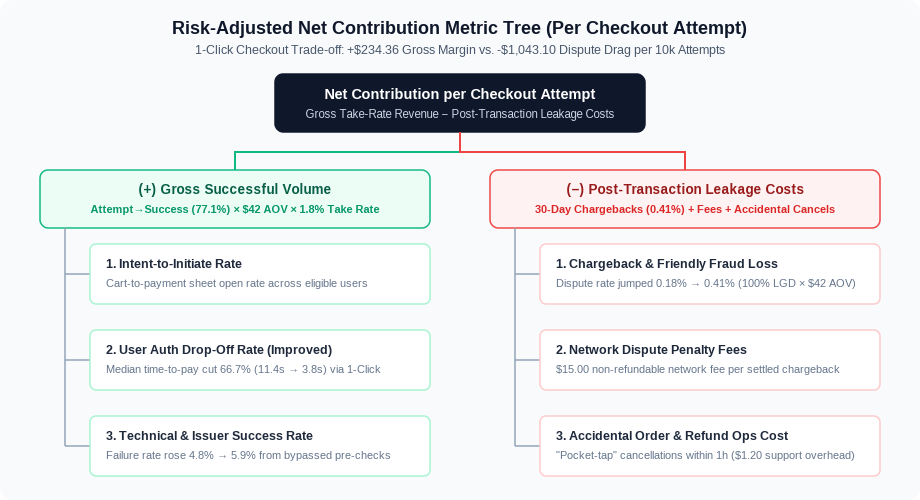
To align Product, Risk, and Finance around a single decision criterion, decompose top-line GMV into Net Risk-Adjusted Contribution per Checkout Attempt:
The Breakeven Math
Assume a 1.8% net take rate on a $42 AOV ($0.756 gross revenue per successful transaction) and a 100% loss-given-default plus a $15 network penalty ($57 total loss) on every settled chargeback:
- Incremental Gross Revenue per 10,000 Attempts:
310 incremental successful orders × $0.756 = +$234.36 - Incremental Chargeback Cost per 10,000 Attempts:
Control had
7,400 × 0.18% = 13.3disputes. Treatment had7,710 × 0.41% = 31.6disputes.18.3 incremental disputes × $57.00 = -$1,043.10
Even though checkout conversion rose by over 4%, the net contribution per 10,000 attempts dropped by -$808.74. The feature was value-destructive at broad rollout—but highly profitable if gated strictly to low-risk, high-tenure cohorts.
3. Three Experimentation Traps in Checkout Analytics
Trap 1: Peeking Before the Dispute Maturity Window
Checkout conversion is instantaneous; chargebacks and friendly fraud take 15 to 45 days to surface via bank settlement files. Evaluating a checkout experiment at Day 7 compares realized conversion against censored risk. Always pair a 14-day conversion readout with a right-censored survival curve of early dispute signals (e.g., 24-hour customer support “I didn’t mean to pay” tickets and immediate post-order cancellations).
Trap 2: Triggered vs. Intent-to-Treat (ITT) Dilution
If only 35% of checkout sessions qualify for 1-Click eligibility, analyzing the entire checkout population dilutes both the conversion lift and the fraud spike by nearly 3x. Always log a shadow eligibility flag in the Control group so you can run a clean Triggered Analysis comparing eligible Control users directly against eligible Treatment users.
Trap 3: Ignoring Downstream Retry Cannibalization
A user who abandons a 2-step flow often retries 2 minutes later and succeeds. Measure Session-Level Ultimate Conversion (within a 30-minute window) rather than Attempt-Level Conversion, otherwise a flow that triggers duplicate attempts will artificially inflate failure denominators or mask true recovery.
4. Production SQL: Cohort-Level Risk-Adjusted Margin Audit
This query evaluates an A/B test across user tenure and transaction-value tiers, joining checkout attempts with matured 30-day dispute and cancellation records to isolate which segments are genuinely net-positive.
WITH experiment_sessions AS (
    SELECT
        e.user_id,
        e.variant,                                 -- 'control' vs 'treatment_1click'
        e.session_id,
        e.checkout_attempt_ts,
        e.order_amount,
        CASE
            WHEN e.prior_txn_count >= 10 AND e.account_age_days >= 180 THEN 'Tier_1_High_Trust'
            WHEN e.prior_txn_count >= 3  AND e.account_age_days >= 30  THEN 'Tier_2_Mid_Trust'
            ELSE 'Tier_3_Low_Trust'
        END AS trust_segment,
        MAX(CASE WHEN p.status = 'SUCCESS' THEN 1 ELSE 0 END) AS is_session_success,
        MAX(CASE WHEN p.status = 'SUCCESS' THEN p.order_amount ELSE 0 END) AS realized_gmv
    FROM analytics.checkout_experiment_assignments e
    LEFT JOIN analytics.payment_attempts p
        ON e.session_id = p.session_id
        AND p.attempt_ts BETWEEN e.checkout_attempt_ts
                             AND e.checkout_attempt_ts + INTERVAL '30' MINUTE
    WHERE e.is_1click_eligible = TRUE              -- Triggered population only
      AND e.checkout_attempt_ts >= CURRENT_DATE - INTERVAL '45' DAY
      AND e.checkout_attempt_ts <  CURRENT_DATE - INTERVAL '30' DAY -- Ensure 30d dispute maturity
    GROUP BY 1, 2, 3, 4, 5, 6
),
post_txn_leakage AS (
    SELECT
        s.session_id,
        MAX(CASE WHEN d.dispute_type = 'CHARGEBACK' THEN 1 ELSE 0 END) AS has_chargeback,
        MAX(CASE WHEN c.cancel_reason = 'ACCIDENTAL_ORDER'
                  AND c.cancel_ts <= s.checkout_attempt_ts + INTERVAL '1' HOUR
                 THEN 1 ELSE 0 END) AS is_accidental_cancel
    FROM experiment_sessions s
    LEFT JOIN analytics.payment_disputes d
        ON s.session_id = d.session_id
        AND d.dispute_created_ts <= s.checkout_attempt_ts + INTERVAL '30' DAY
    LEFT JOIN analytics.order_cancellations c
        ON s.session_id = c.session_id
    GROUP BY 1
)
SELECT
    s.trust_segment,
    s.variant,
    COUNT(DISTINCT s.session_id) AS eligible_sessions,
    ROUND(100.0 * AVG(s.is_session_success), 2) AS session_conv_pct,
    ROUND(100.0 * SUM(l.is_accidental_cancel) / NULLIF(SUM(s.is_session_success), 0), 2) AS accidental_cancel_pct,
    ROUND(100.0 * SUM(l.has_chargeback) / NULLIF(SUM(s.is_session_success), 0), 3) AS chargeback_rate_pct,
    -- Net Contribution ($) = (GMV * 1.8% take rate) - (Chargebacks * (Order Amount + $15 fee)) - (Accidental Cancels * $1.20 ops cost)
    ROUND(
        (
            SUM(s.realized_gmv * 0.018)
            - SUM(CASE WHEN l.has_chargeback = 1 THEN s.realized_gmv + 15.0 ELSE 0 END)
            - SUM(CASE WHEN l.is_accidental_cancel = 1 THEN 1.20 ELSE 0 END)
        ) / COUNT(DISTINCT s.session_id),
        4
    ) AS net_contribution_per_session_usd
FROM experiment_sessions s
JOIN post_txn_leakage l
    ON s.session_id = l.session_id
GROUP BY 1, 2
ORDER BY 1, 2;
5. Actionable Rollout Recommendation
Instead of a binary ship/kill decision, use the segmented output above to deploy a Dynamic Friction Policy:
- Ship 1-Click Checkout to
Tier_1_High_Trust(>= 10prior transactions,>= 180days tenure) for orders under $50: Conversion lift holds at +3.6% while chargeback variance stays statistically indistinguishable from Control (< +0.02%), yielding a net positive contribution lift. - Require Step-Up Confirmation for High-Ticket &
Tier_2Sessions: Retain the 2-step confirmation screen whenever order value exceeds$50or account tenure is under 6 months, where a single dispute erases the margin of ~75 successful transactions. - Add a 5-Second “Undo / Cancel” Toast Post-Tap: For 1-Click orders, allow instant self-serve cancellation within 5 seconds before merchant fulfillment triggers—converting potential chargebacks into zero-fee pre-settlement voids.